
Artificial intelligence is becoming part of everyday business software. Companies are using AI to automate repetitive work, improve customer support, analyze information, build smarter applications, personalize digital experiences, and introduce new features into existing products.
But taking an AI idea from planning to a working product requires people who understand how to build, integrate, test, and maintain these systems.
For many businesses, building a large internal AI department is not the most practical starting point. Recruiting several full-time specialists can take time, increase fixed costs, and create unnecessary overhead when the company may initially need expertise for only one product, feature, or phase of development.
A more flexible approach is to Hire AI Developers according to the skills, timeline, and scope of the project. Businesses can bring experienced AI talent into an existing development team, create a dedicated external team, or expand technical capacity as the project grows.
The key is not simply finding developers who know AI. It is finding the right expertise for the specific business problem you want to solve.
Why Businesses Need AI Developers
Using an off-the-shelf AI tool and building an AI-powered business application are two very different things.
A company may be able to experiment with a chatbot or content-generation platform within minutes. Building AI into an actual product, however, usually requires much more.
An AI developer may need to understand how the existing software works, connect AI models with company data, build APIs, develop business logic, integrate databases, create automation workflows, manage user access, test outputs, and make the complete application reliable enough for everyday use.
Businesses may need AI development expertise for projects such as:
- AI-powered web applications
- Intelligent mobile apps
- AI chatbots and virtual assistants
- Generative AI applications
- AI copilots
- Recommendation systems
- Predictive analytics
- Document processing
- Natural language processing
- Computer vision applications
- AI workflow automation
- Intelligent search
- AI agents
- Custom AI software
The exact skills required depend on what the business is trying to build.
That is why companies should define the project before they begin searching for AI Developers for Hire.
Why Building a Large In-House AI Team Is Not Always Necessary
Hiring an internal team can make sense for organizations where AI is a permanent and significant part of the company's long-term product strategy.
However, not every business needs to begin that way.
Imagine a SaaS company that wants to add an intelligent assistant to an existing platform.
It may need AI expertise for model selection, application development, integration, testing, and deployment. Once the feature is running, the amount of specialized development work may decrease significantly.
Hiring a large permanent department before understanding the long-term workload can create unnecessary costs.
The same issue applies to startups.
A startup developing an AI MVP may need several specialists during the initial product-development stage but may not need the same team structure six months later.
A flexible hiring approach makes it possible to increase or reduce technical capacity based on actual project requirements.
Start With the Business Problem, Not the AI Technology
One of the most important steps before hiring AI developers is deciding exactly what you want them to build.
"We want to use AI" is not enough.
A better requirement might be:
"We want to reduce the amount of time our customer support team spends searching our knowledge base."
That problem could lead to an intelligent knowledge assistant.
Another company might say:
"Our sales team spends too much time reviewing customer records before meetings."
That could lead to an AI feature that summarizes account information and previous conversations.
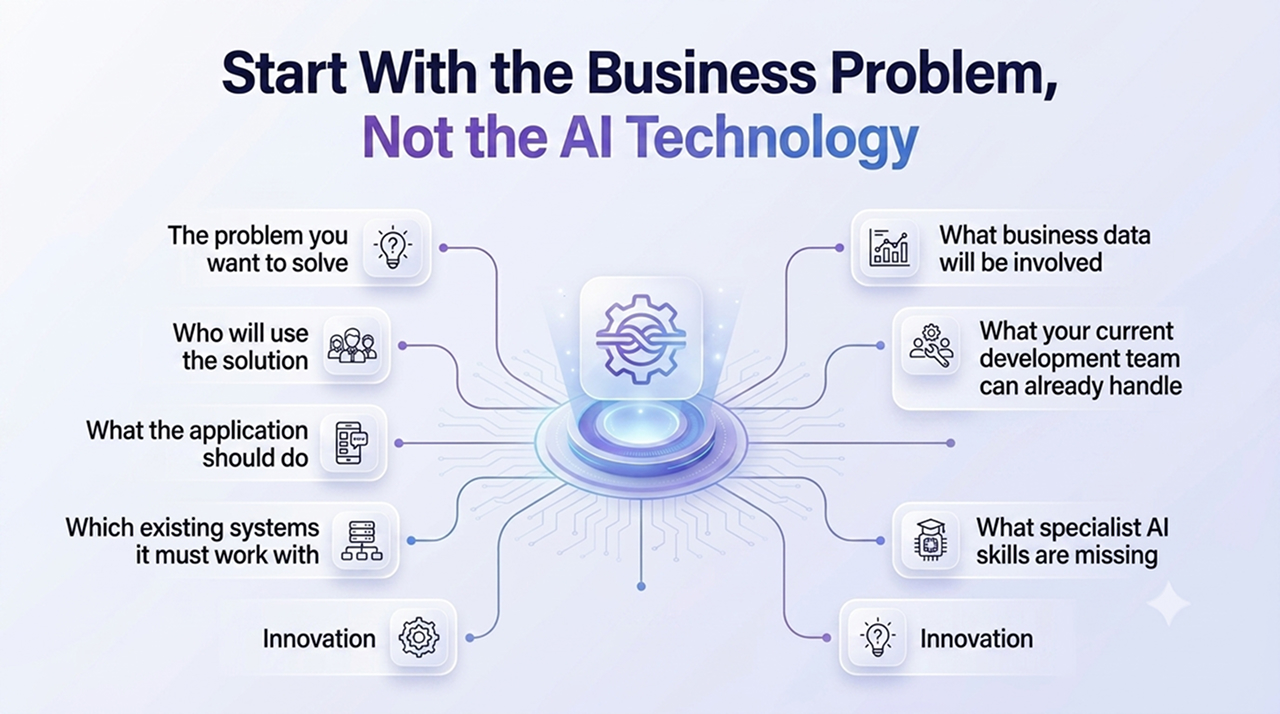
Before beginning the hiring process, define:
- The problem you want to solve
- Who will use the solution
- What the application should do
- Which existing systems it must work with
- What business data will be involved
- What your current development team can already handle
- What specialist AI skills are missing
Businesses that need help turning an AI opportunity into a technical development plan can start with AI/ML Development Services before deciding how much dedicated talent the project requires.
Understand What Type of AI Developer You Need
AI development covers a large number of technologies.
Someone who is highly experienced with machine learning models may not necessarily be the best developer for a generative AI chatbot. A computer vision specialist may not be the right person to design an NLP-based document assistant.
Businesses therefore need to match technical expertise to the project.
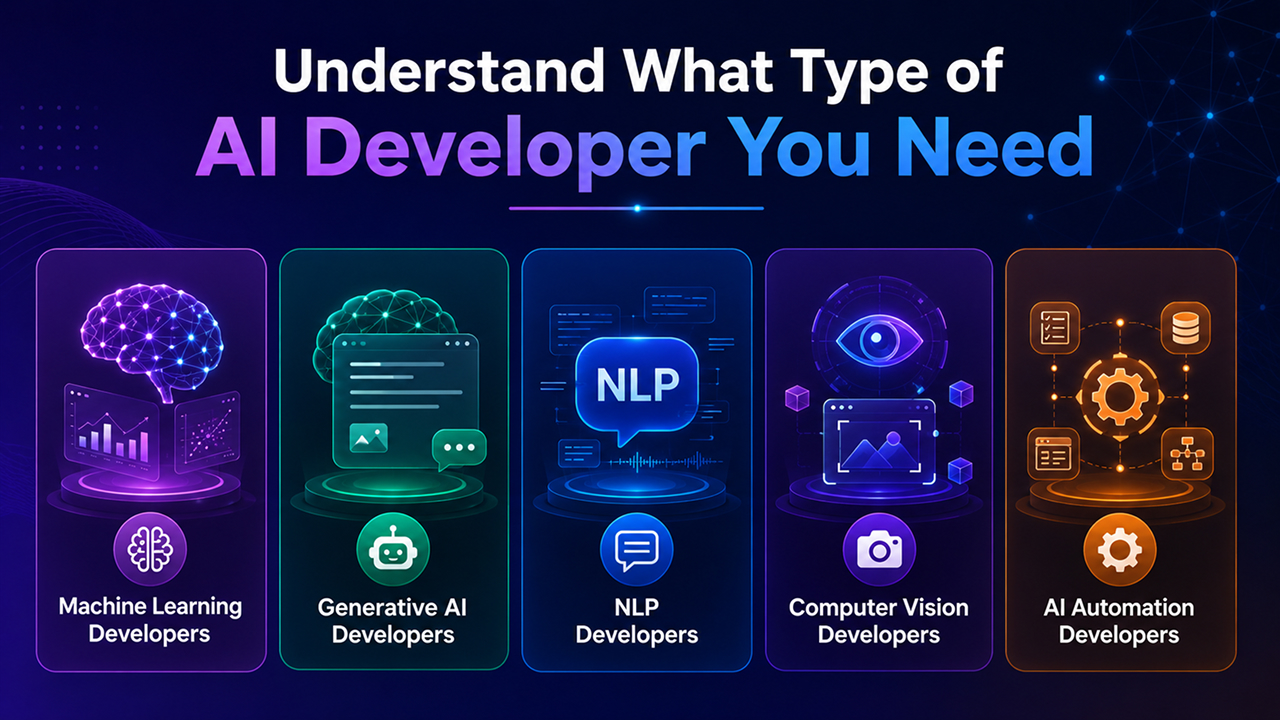
Machine Learning Developers
Machine learning developers work on systems that learn from data to identify patterns, generate predictions, classify information, or support automated decisions.
They may be needed for projects involving recommendation engines, forecasting, predictive analytics, fraud detection, customer segmentation, and other data-driven applications.
Generative AI Developers
Generative AI developers work with technologies that can generate and understand text, images, code, and other forms of content.
Businesses may need them to build AI assistants, copilots, chatbots, RAG applications, intelligent knowledge systems, content tools, and LLM-powered applications.
Companies specifically developing these kinds of products can also explore Thinkwik's Generative AI Development Services.
NLP Developers
Natural language processing developers work with applications that need to understand or process human language.
They may develop document-processing systems, sentiment analysis, text classification, information extraction, intelligent search, and conversational applications.
Computer Vision Developers
Computer vision developers work on systems that interpret images and videos.
They can be required for image recognition, object detection, visual inspection, OCR, video analytics, and similar applications.
AI Automation Developers
Some businesses do not need a completely new AI product. They need AI to improve an existing workflow.
For example, a company may want AI to categorize support tickets, process incoming documents, generate summaries, or help move information between different systems.
In these cases, experience with AI Automation Services and software integrations may be just as important as experience with AI models themselves.
Should You Hire AI Developers or Hire AI Engineers?
The terms AI developer and AI engineer are sometimes used interchangeably, but the role required can vary depending on the project.
When businesses Hire AI Developers, they are often looking for professionals who can build AI functionality into a wider software application.
Their work may include:
- API development
- AI model integration
- Application logic
- Backend development
- AI-powered features
- Database connectivity
- User-facing AI functionality
- Workflow integration
Businesses looking to Hire AI Engineers may have requirements that go deeper into model development, infrastructure, model training, deployment, optimization, or machine learning operations.
For example, an AI engineer may be required when a business needs to train or fine-tune models, create sophisticated machine learning pipelines, optimize model performance, or manage AI systems at scale.
There is often overlap between the two roles.
The important thing is not the job title. It is whether the person's skills match the work that needs to be completed.
Identify the Skills Your Existing Team Already Has
Before adding new developers, businesses should assess their existing technical team.
An organization may already have strong frontend, backend, database, cloud, and mobile developers.
If so, it may not need an entirely separate external product team.
It might only need one or two specialized AI developers who can work alongside the current engineers.
For example, an existing SaaS team may already understand the product architecture and user experience.
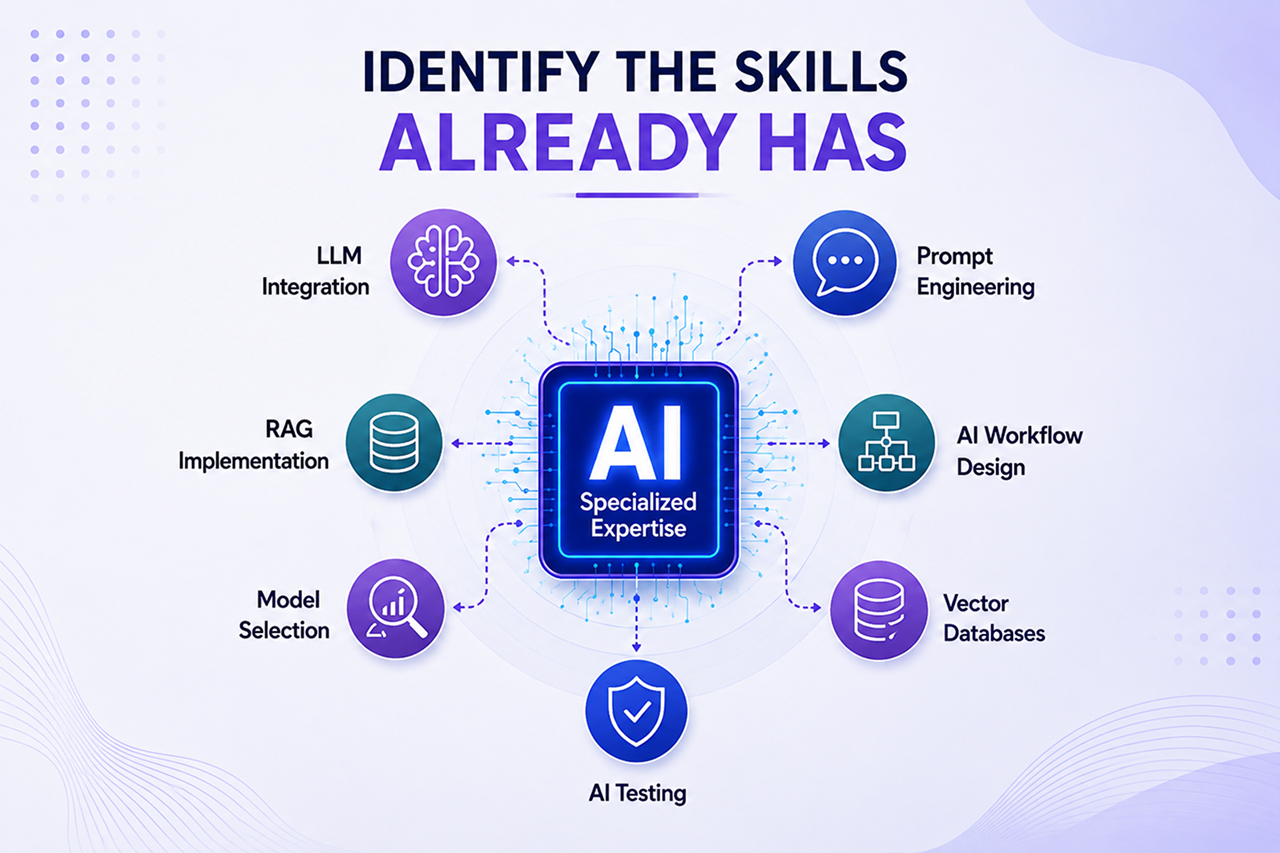
An external AI developer could focus on:
- LLM integration
- RAG implementation
- Model selection
- Prompt engineering
- AI workflow design
- Vector databases
- AI testing
The internal team can continue handling the rest of the product.
This approach allows companies to add specialized knowledge without duplicating skills they already have.
Choose the Right Hiring Model
There is no single AI hiring model that works for every business.
The right approach depends on project size, internal capabilities, budget, expected duration, and how quickly the company needs to begin development.
Dedicated AI Developers
Hiring dedicated AI developers works well when a business needs one or more specialists who can work closely with an existing team for an extended period.
The developers effectively become part of the project team without requiring the company to permanently expand its internal workforce.
This can be particularly useful when the project scope is expected to evolve.
Dedicated AI Development Team
Some businesses need a larger combination of skills.
Instead of hiring individual developers, they may use a dedicated team that includes AI developers, software engineers, designers, quality assurance specialists, and project management.
This works well when the company has an idea and product direction but does not have enough internal development capacity to build the complete application.
Project-Based AI Development
A project-based approach may be better when the scope, functionality, and expected deliverables are already clearly defined.
The external development team is responsible for delivering the agreed project rather than simply providing additional technical resources.
Team Augmentation
Team augmentation is useful when an internal development team already exists but has a particular skills gap.
For example, a company might have eight software developers but no one experienced with LLM-powered applications.
Rather than recruiting an entire AI department, the business can add experienced specialists to the current team.
This is one of the most practical ways to access AI Developers for Hire without significantly changing the existing organizational structure.
Look for Software Development Experience, Not Only AI Knowledge
AI is rarely a standalone component in a production application.
An intelligent feature normally sits inside a wider software system.
That system may have:
- User accounts
- Databases
- APIs
- Web interfaces
- Mobile applications
- Authentication
- Payment systems
- Cloud infrastructure
- Customer information
- Business workflows
A developer may understand an AI model extremely well but still struggle to build a reliable production application around it.
This is why businesses should evaluate software engineering experience alongside AI expertise.
Developers should understand how the AI component will fit into the wider architecture.
Companies building a complete custom AI product rather than one isolated feature may benefit from Custom AI Software Development expertise that combines AI with the wider application-development process.
Evaluate Developers Based on Relevant AI Experience
A long list of technologies on a developer profile does not automatically mean the person is suitable for your project.
Look for experience that is relevant to what you actually want to build.
If you need a customer support assistant, ask about previous experience with:
- LLM applications
- Chatbots
- Knowledge bases
- RAG
- CRM integrations
- Conversational interfaces
If you need predictive software, look for experience with:
- Machine learning
- Data preparation
- Model training
- Forecasting
- Model evaluation
If you are developing AI agents, look for developers who understand tools, workflows, system integrations, guardrails, and multi-step task execution.
Projects involving autonomous or semi-autonomous systems can also require specialist AI Agent Development Services.
Relevant experience usually matters more than the number of technologies someone claims to know.
Ask Developers How They Would Approach Your Problem
Technical interviews should not be limited to programming questions.
One of the best ways to evaluate an AI developer is to give them a simplified version of the business problem and ask how they would approach it.
For example:
"We have 10,000 support documents and want employees to ask questions about them. How would you approach this?"
The response can reveal a great deal.
A good developer should think beyond simply connecting to an AI model.
They may ask about document formats, data quality, permissions, expected number of users, response accuracy, how frequently documents change, and whether users need to see source references.
Those questions demonstrate that the developer is thinking about the actual product rather than only the underlying technology.
Do Not Hire a Large Team Before Validating the Idea
Many AI ideas sound valuable in theory.
That does not mean users will necessarily adopt them.
Before committing to a large development team, businesses can build a small proof of concept or minimum viable product.
For example, instead of immediately creating an enterprise-wide AI knowledge platform, begin with one department and a limited set of documents.
Measure whether employees actually use it.
Understand which questions they ask.
Identify where the AI produces useful answers and where it struggles.
Then improve the product before expanding it.
This allows companies to invest based on evidence rather than assumptions.
A smaller initial team also makes it easier to learn what additional skills will be required later.
Make Integration Skills a Priority
An AI system becomes much more valuable when it can work with existing business software.
A customer support assistant may need information from the CRM.
An AI reporting tool may need access to business databases.
A sales assistant may need to interact with customer records.
An AI automation system may need to connect several applications together.
When reviewing AI Developers for Hire, consider whether they have experience with:
- APIs
- Databases
- CRM integrations
- ERP integrations
- Cloud platforms
- Authentication
- Existing web applications
- Mobile apps
- Enterprise software
- Third-party platforms
Successful AI development often depends on these connections.
AI cannot provide useful business context if it cannot securely access the information required to perform the task.
Consider Security From the Beginning
AI applications may interact with customer information, internal documents, operational records, or confidential business data.
Security therefore needs to be considered during development.
Your AI developers should understand:
- Access control
- Authentication
- Data privacy
- Secure APIs
- Sensitive information handling
- Cloud security
- User permissions
- Application monitoring
Businesses should also determine what information the AI can access and what actions it is allowed to perform.
For example, an employee using an internal AI assistant should not suddenly gain access to documents that their normal account permissions would prevent them from seeing.
AI should operate within the same security expectations as the wider business application.
Define How Human Review Will Work
Businesses sometimes approach AI projects with the assumption that everything should eventually be automated.
That is not always necessary.
Human review can remain part of the workflow.
For example, AI might:
Draft a customer response, while the support agent sends it.
Prepare a financial summary, while the manager reviews the numbers.
Generate a product description, while the marketing team approves the content.
Recommend an action, while an employee makes the final decision.
Good AI developers should understand where automation creates value and where people should remain responsible for the final action.
Set Clear Expectations Before Development Begins
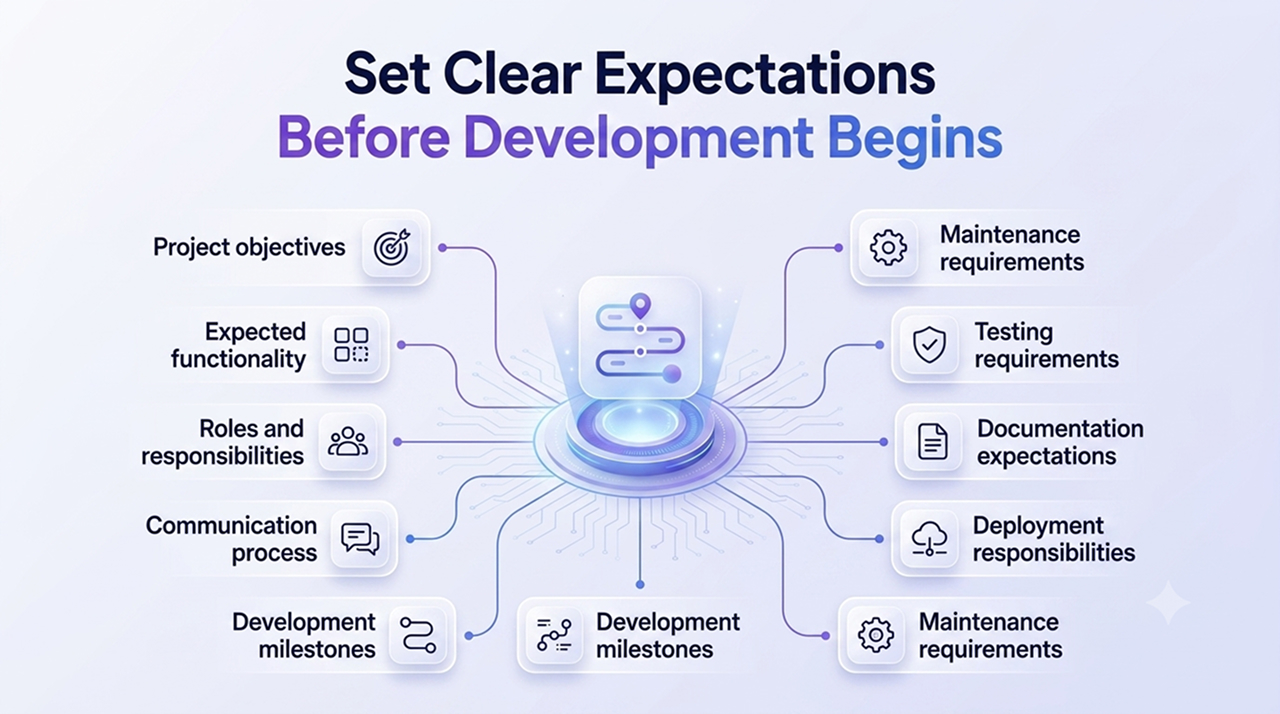
Whether you hire one developer or a complete external AI team, the project needs clear expectations.
Businesses should establish:
- Project objectives
- Expected functionality
- Roles and responsibilities
- Communication process
- Development milestones
- Testing requirements
- Documentation expectations
- Deployment responsibilities
- Maintenance requirements
This becomes particularly important when external developers work alongside an internal team.
Everyone needs to understand who is responsible for each part of the application.
Good collaboration can make an external AI developer feel like an extension of the internal development team rather than a completely separate vendor.
Plan for AI Development After Launch
AI development does not always end when the feature goes live.
Real users may ask questions the development team did not expect.
Business information may change.
AI models may need adjustment.
Prompts may need improvement.
Integrations may evolve.
Usage may grow.
Developers may need to improve response quality, reduce latency, optimize costs, or add additional capabilities.
When businesses Hire AI Engineers or developers, they should consider whether the project will require continuing technical support after deployment.
For some products, ongoing optimization may be relatively small.
For others, especially AI-first products, continuous development may become part of the product roadmap.
When Does Hiring External AI Developers Make Sense?
Bringing in external AI talent can be particularly useful when:
Your internal team does not have enough AI experience.
You need to launch an AI product quickly.
The project requires specialized skills for a limited period.
You want to validate an AI idea before recruiting permanent employees.
Your existing developers need additional technical support.
You need to scale development capacity temporarily.
You are building an MVP or proof of concept.
You need specialized knowledge in generative AI, machine learning, AI agents, automation, NLP, or computer vision.
External AI developers can help businesses access specialized skills without immediately creating a large permanent team.
However, the hiring decision should still be based on project fit, technical ability, communication, and relevant experience rather than cost alone.
Common Mistakes Businesses Make When Hiring AI Developers
Hiring too quickly can create expensive problems later.
One common mistake is searching for a general "AI expert" without clearly defining the project.
Another is hiring based primarily on a long list of tools and technologies.
Businesses also sometimes underestimate the importance of ordinary software-development skills.
The AI feature still needs to work inside a secure, usable, scalable application.
Another mistake is hiring too many developers before validating whether the AI feature solves a valuable problem.
Businesses should instead begin with the smallest team capable of moving the project forward.
As requirements become clearer, the team can grow.
This keeps development focused while reducing unnecessary overhead.
How Thinkwik Helps Businesses Access AI Development Talent
Not every company needs to build an entire AI department before it can begin developing intelligent applications.
Thinkwik helps businesses add AI expertise according to their actual project requirements.
A startup may need AI developers to build an MVP.
A SaaS company may need specialists to introduce AI features into an existing platform.
An enterprise may need additional engineers to support its internal development team.
Another organization may need a complete development team to take an AI project from planning through deployment.
The right approach depends on what the company already has and what it still needs.
Thinkwik's AI development capabilities cover areas including machine learning, generative AI, NLP, AI-powered software, intelligent automation, AI agents, and integrations, allowing businesses to build teams around the project rather than around a fixed hiring structure. Thinkwik currently positions its dedicated AI talent around custom AI development, generative AI, NLP, model development, computer vision, prompt engineering, LLM solutions, and intelligent automation.
Conclusion
Businesses do not need a large permanent AI department to begin building useful AI applications.
What they need is the right combination of skills at the right stage of the project.
Start by defining the problem. Understand which AI capabilities are actually required. Review the expertise already available internally, identify the gaps, and choose a hiring model that matches the project rather than creating a large team simply because AI is becoming important.
When evaluating AI Developers for Hire, look beyond buzzwords. Consider their relevant project experience, software engineering skills, understanding of business applications, integration knowledge, security awareness, and ability to work with your existing team.
Whether you need one specialist, several dedicated developers, or a complete AI development team, Thinkwik gives businesses a flexible way to Hire AI Developers without having to build a large in-house department from the beginning.
The goal is not to hire the biggest AI team.
It is to build the right team for the problem you actually want to solve.