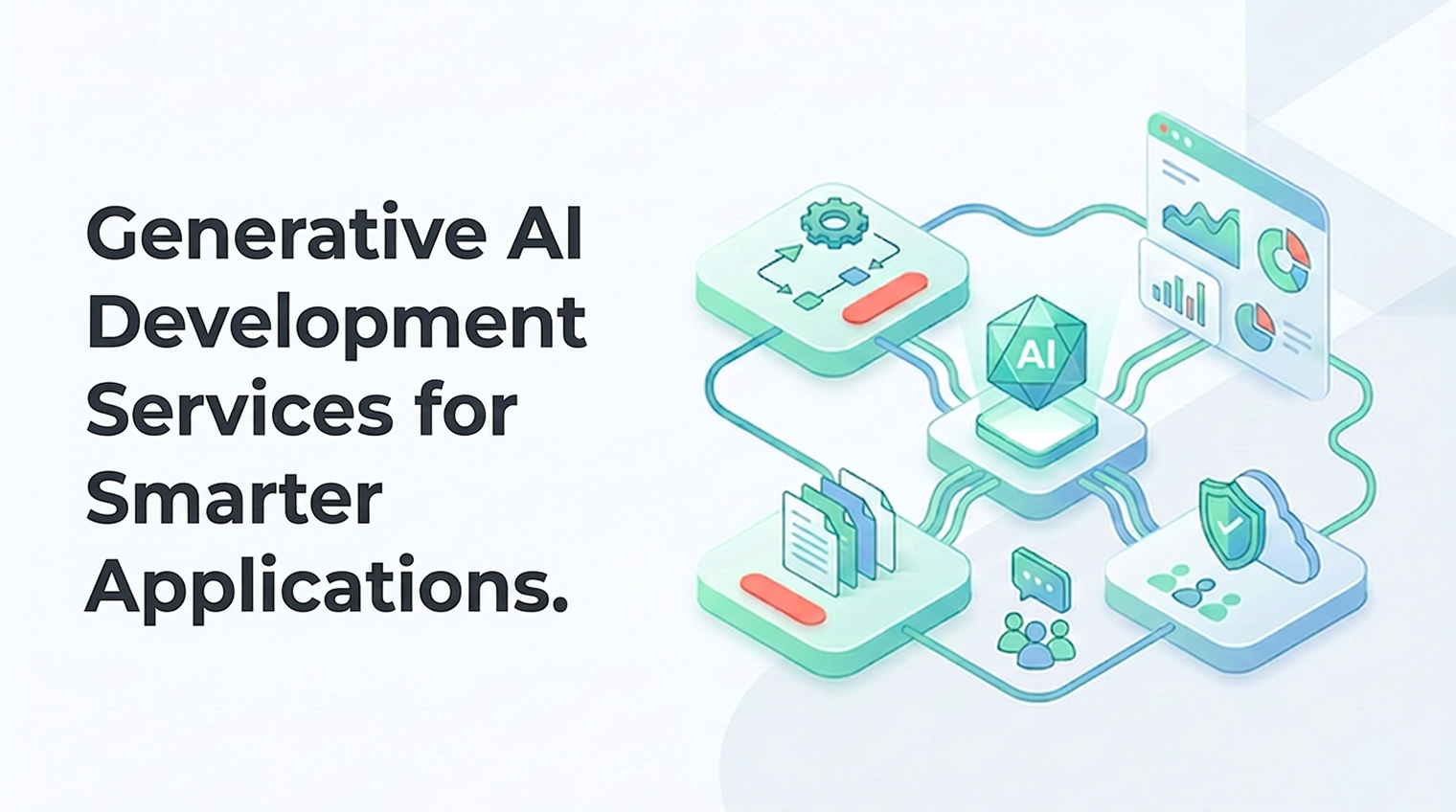

Generative AI Development Services for Building Smarter Business Applications
Business applications have come a long way from simply storing information and helping users complete predefined tasks. Today, businesses expect software to do more. They want applications that can understand questions, work with business data, assist employees, automate repetitive activities, improve customer interactions, and make everyday work easier.
Generative AI is helping make that possible.
Instead of treating AI as a separate tool, businesses can now build it directly into websites, mobile apps, SaaS products, internal platforms, customer portals, CRM systems, support applications, and other digital products.
With the right Generative AI Development Services, businesses can turn ordinary applications into more useful digital experiences that help people find information faster, complete tasks with less effort, and get better support while they work.
The opportunity is not about adding AI everywhere. It is about understanding where AI can genuinely make an application better.
What Are Generative AI Development Services?
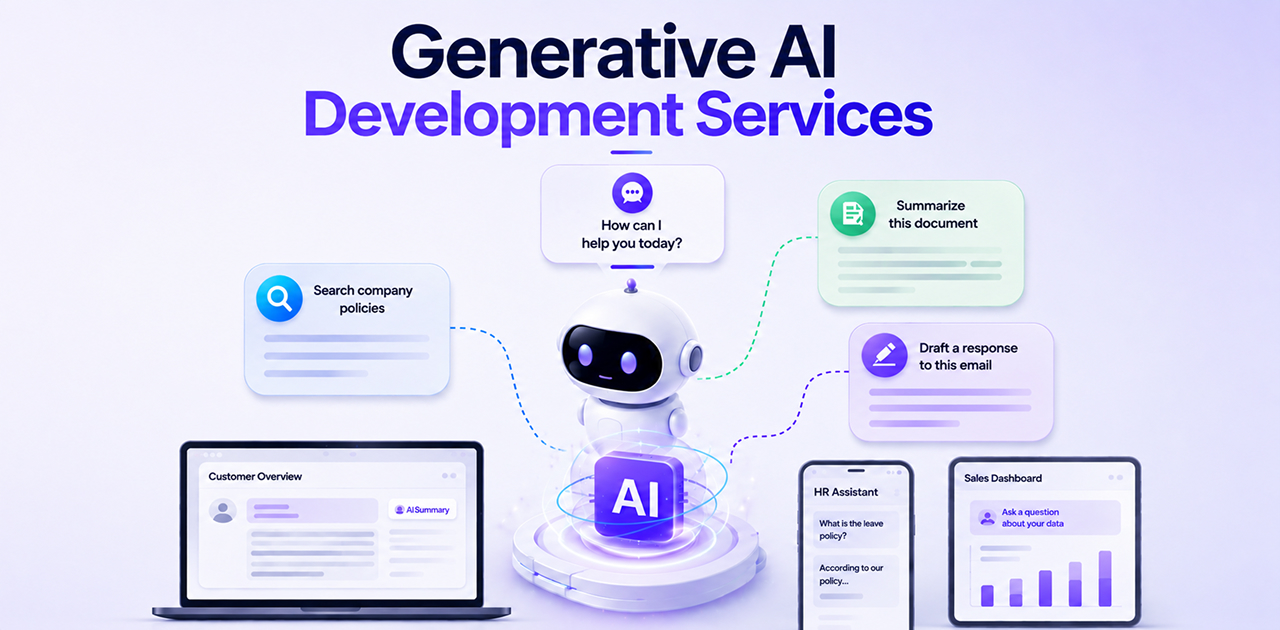
Generative AI Development Services involve designing and building applications or features that use generative artificial intelligence to create, understand, summarize, recommend, search, communicate, or assist with business tasks.
For example, a company may use generative AI to create an assistant that answers customer questions, summarizes documents, drafts reports, prepares responses, searches internal knowledge, or helps employees complete routine activities.
Generative AI can also be added to an existing business application instead of building an entirely new platform.
A customer management system could use AI to summarize customer history before a sales call. An HR platform could help employees find answers from company policies. A SaaS application could allow users to ask questions about their data instead of manually navigating several reports.
The technology becomes valuable when it solves a practical problem for the person using the application.
Why Businesses Are Investing in Generative AI
Most businesses already have large amounts of information spread across different systems.
Employees may work with CRM software, spreadsheets, documents, project management platforms, support systems, internal applications, databases, and communication tools throughout the day.
Even when all the necessary information exists, finding and using it can take time.
Generative AI can simplify this experience.
Instead of opening five different documents to understand a policy, an employee can ask a question and receive a useful summary.
Instead of manually reviewing a long customer conversation, a support agent can receive the important points within seconds.
Instead of starting a report from a blank page, a manager can generate an initial draft based on existing information and then review it.
This is why demand for Generative AI Software Development is growing beyond experimental chatbots. Businesses are beginning to use AI as part of their actual software and everyday workflows.
How Generative AI Can Make Business Applications Smarter
A smarter application does not need to look futuristic.
In fact, the most useful AI features are often the ones that quietly make an existing process simpler.
Smarter Search
Searching business information can be frustrating when users do not know the exact keyword, file name, or location of the information they need.
Generative AI can allow people to search using normal questions.
For example:
"What were the main customer complaints this month?"
"Show me the important points from this contract."
"What is our policy for international refunds?"
The application can understand the request and help the user reach the relevant information faster.
For businesses that want to combine AI with machine learning, predictive systems, data analysis, or intelligent business applications, Thinkwik also provides AI/ML Development Services.
Better Customer Support
Customer support teams repeatedly answer similar questions, review previous conversations, search company documentation, and prepare responses.
Generative AI can assist throughout this process.
An AI-powered support application can understand a customer's question, summarize previous interactions, identify relevant information, and prepare a suggested response for the support team.
Businesses can also create customer-facing assistants for common queries.
This does not mean every customer interaction needs to be automated. AI can support employees while leaving important decisions and complex conversations with people.
The result can be a faster support experience without making it feel impersonal.
Easier Document Handling
Businesses deal with documents every day.
Contracts, reports, proposals, policies, invoices, manuals, product information, customer documents, and internal files can quickly become difficult to manage.
Generative AI can help users understand these documents without reading every page manually.
A business application could allow a user to ask:
"Give me the key points from this document."
"Which payment terms are mentioned?"
"Summarize the responsibilities of each party."
"Find everything related to cancellation."
This can be especially useful for teams that regularly work with large amounts of written information.
Generative AI for Sales and CRM Applications
Sales teams spend a large part of their day working with information.
They review customer records, previous emails, meeting notes, deals, requirements, and follow-up activities.
Generative AI can help turn that information into useful context.
Before a meeting, a salesperson could receive a short summary of the customer account, recent conversations, important requirements, and outstanding actions.
After a meeting, AI could help summarize notes and prepare a follow-up draft.
Instead of replacing the salesperson, the application reduces some of the repetitive administrative work around selling.
A Generative AI Development Company building this type of application needs to think about more than the AI model. The AI feature has to work naturally with the CRM, customer records, permissions, workflows, and existing software.
That is what makes custom AI development different from simply using a public AI tool.
Generative AI for SaaS Products
Generative AI offers a major opportunity for SaaS companies because AI features can often be added directly to an existing product.
A SaaS business does not necessarily need to rebuild its entire platform.
It may introduce one or two intelligent features that make the existing product much easier to use.
For example, a project management platform could generate a summary of delayed tasks.
An analytics platform could explain important changes in business performance using simple language.
A marketing platform could help users create an initial campaign draft.
An HR application could answer employee questions using company information.
A customer service platform could generate summaries of open tickets.
Generative AI App Development should therefore begin with the user's existing journey.
Where are users spending too much time?
What are they repeatedly searching for?
Which steps require unnecessary manual work?
Which part of the application could become easier if users could simply ask for what they need?
Those questions usually lead to more valuable AI features than starting with the technology itself.
Building Custom Generative AI Software Around Your Business
Ready-made AI tools can be useful, but every business works differently.
A company has its own processes, customers, terminology, products, data, internal systems, policies, and ways of working.
Custom Generative AI Software Development makes it possible to build AI around that specific environment.
For example, a general AI assistant may know how to write a sales proposal.
A custom system could prepare that proposal while considering the company's own services, customer information, previous proposals, pricing structure, and preferred format.
That added context is what makes business-specific AI much more useful.
For companies that need a broader custom application rather than only one generative AI feature, Thinkwik's Custom AI Software Development can support the development of AI-powered software around specific processes, data, and product requirements.
Connecting Generative AI With Existing Business Software
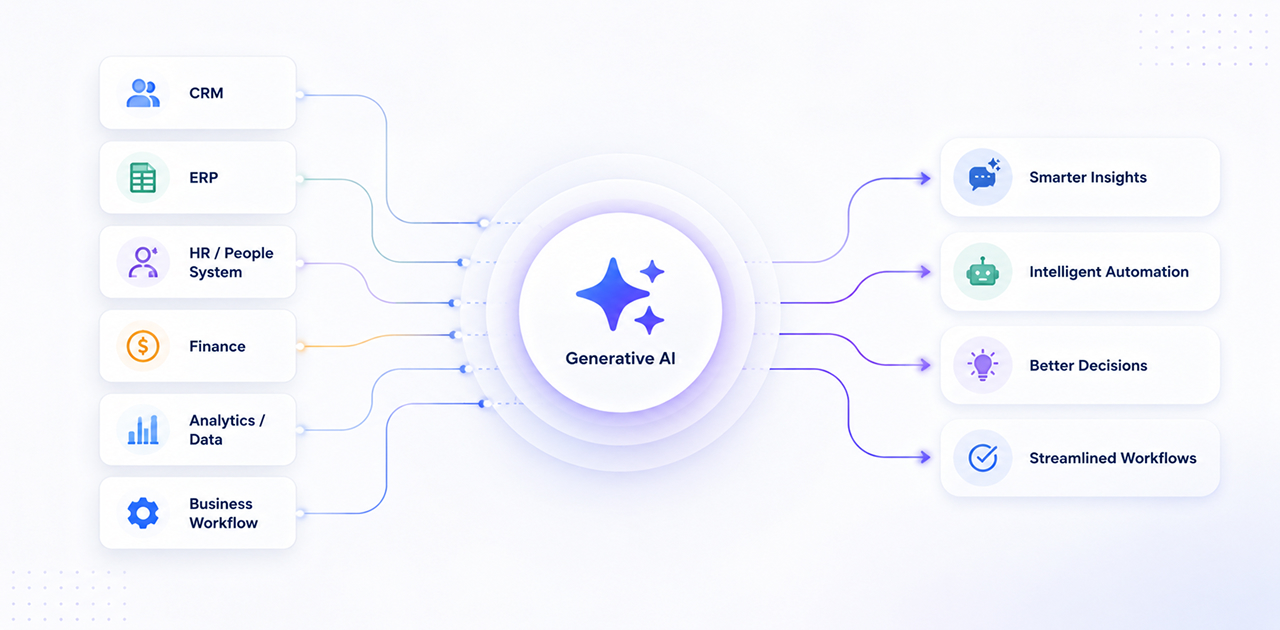
One of the most important parts of a useful AI application is integration.
An AI assistant becomes much more helpful when it can work with the systems a business already uses.
Depending on the project, AI may need to connect with:
- CRM platforms
- ERP software
- Customer databases
- Help desk systems
- Internal applications
- Ecommerce platforms
- Document repositories
- Business APIs
- Marketing platforms
- Cloud systems
- Reporting tools
This is where Generative AI Integration Services become especially important.
Instead of creating another disconnected application, businesses can introduce intelligence into the software and workflows employees already understand.
For organizations looking to automate repetitive operations across connected applications and workflows, Thinkwik's AI Automation Services can also support intelligent process automation.
The difference matters.
Generative AI may help create, understand, or summarize information, while automation can help move that information through an actual business process.
Together, they can reduce significant amounts of repetitive work.
Generative AI for Internal Business Applications
Customer-facing AI receives a lot of attention, but internal applications can be equally valuable.
Employees often spend time finding information, preparing routine documents, updating systems, answering internal questions, and moving information between tools.
Generative AI can make these internal applications easier to use.
An internal AI assistant could help employees find policies, summarize project updates, prepare meeting notes, explain processes, draft internal communications, or locate information from company documents.
A manager could ask for a summary of outstanding project issues without manually opening every task.
A new employee could ask questions about internal procedures rather than searching through a long collection of documents.
A support manager could ask for the most common customer issues from the previous week.
These are not dramatic examples, but they solve real everyday problems.
That is where many businesses can achieve practical value from generative AI.
Using Generative AI for Business Automation
Generative AI becomes even more useful when it can participate in a workflow instead of only answering a question.
Imagine a business receiving hundreds of customer inquiries.
A traditional process may involve an employee reading every inquiry, deciding what it is about, finding relevant information, preparing a response, and assigning it to the correct department.
An AI-enabled workflow could help understand the message, categorize it, prepare a summary, identify useful information, and suggest the next action.
The employee then reviews the result before the process continues.
This approach can reduce manual effort while keeping people involved where their judgment matters.
Businesses do not have to automate an entire process on day one. Starting with one repetitive step can often be more effective.
Generative AI and AI Agents: What Is the Difference?
Generative AI and AI agents are closely connected, but they are not exactly the same thing.
A generative AI application may answer a question, summarize information, generate content, or provide recommendations.
An AI agent can go further by working through multiple steps and interacting with approved tools or business systems.
For example, an AI assistant might tell an employee how to create a customer support ticket.
An AI agent could collect the necessary information, determine the ticket category, and create the ticket through an integrated system.
This creates opportunities for more advanced business applications where AI helps complete tasks rather than only provide information.
Companies exploring this type of intelligent automation can use AI Agent Development Services to build agents around specific business workflows and operational requirements.
Where Generative AI Consulting Services Add Value
Businesses often know they want to use generative AI but are less certain about where to begin.
This is where Generative AI Consulting Services can be valuable.
The first step should not always be software development.
Businesses need to identify where AI can produce meaningful results.
A useful AI planning process should answer questions such as:
What problem should the application solve?
Who will use it?
Which business information does it need?
Does generative AI actually suit the problem?
Should the solution be added to an existing application or built separately?
Which processes should remain under human control?
How will success be measured?
Answering these questions early can prevent businesses from spending time building AI features that users do not actually need.
Security and Human Review Still Matter
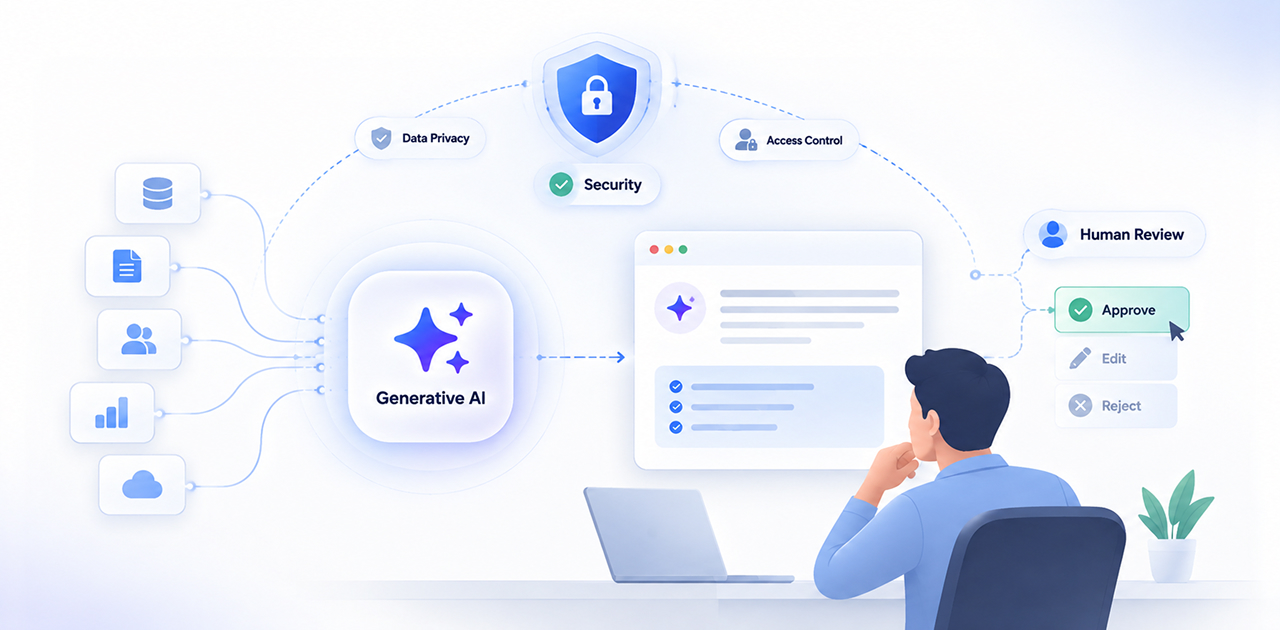
Generative AI can make applications more helpful, but businesses should not assume every AI response will always be correct.
The level of human review should depend on what the application is doing.
If AI is preparing an initial marketing draft, an employee can review it before publication.
If an application is summarizing a business document, users should still be able to check the original information.
If AI is helping with a sensitive customer, financial, or operational decision, stronger controls may be needed.
Access is equally important.
An AI assistant should not allow someone to retrieve information they would not normally have permission to access.
Good generative AI development therefore needs to consider the complete application experience, not only whether the model can generate a convincing response.
Should You Build In-House or Hire Generative AI Developers?
Some businesses already have experienced software teams but need specialized AI knowledge for a particular project.
Others want an external team to handle the entire application.
There is no single correct approach.
Businesses may choose to Hire Generative AI Developers when they need additional experience with AI applications, LLM integration, intelligent assistants, automation, business data, AI agents, or other areas that are outside the existing team's expertise.
Thinkwik also provides businesses with the option to Hire AI Developers for dedicated AI development requirements.
The important part is choosing developers who understand software as well as AI.
A useful business application requires more than writing prompts or connecting to a model. Developers need to consider how the feature fits into the product, how users interact with it, where its information comes from, and how the application will perform as usage grows.
How to Choose a Generative AI Development Company
Choosing the right Generative AI Development Company should begin with its ability to understand the business problem.
A strong development partner should not recommend AI for every challenge.
Instead, the team should first understand what the business wants to improve.
That may be reducing repetitive work, improving customer support, making internal knowledge easier to access, building a smarter SaaS product, or creating a completely new AI-powered application.
Businesses should also consider whether the development company can handle the wider software requirements around AI.
This may include application development, APIs, databases, cloud infrastructure, integrations, user experience, testing, deployment, and ongoing improvements.
The final product still needs to be good software.
AI is simply one of the technologies making that software more useful.
How Thinkwik Helps Businesses Build Practical Generative AI Solutions
Thinkwik approaches generative AI as part of the wider business application rather than treating it as an isolated feature.
A company may need an intelligent customer assistant. Another may want AI added to an existing SaaS platform. One business may need document intelligence, while another may be trying to automate an internal workflow.
These requirements are different, which is why generative AI applications should be designed around the actual users and business processes involved.
The aim is to build AI functionality that has a clear purpose.
That could mean helping employees work faster, giving customers better support, simplifying access to business knowledge, reducing repetitive activities, or making a digital product more useful. For businesses, this practical approach is much more important than simply being able to say an application "uses AI."
Conclusion
Generative AI is changing what businesses can expect from their applications.
Software can now do more than wait for users to search, type, filter, read, and complete every step manually. It can help people understand information, find answers, create content, summarize documents, support customers, and move through everyday tasks more efficiently.
But adding generative AI does not automatically make an application smarter.
The real value comes from identifying where users struggle, where teams lose time, and where better access to information could improve the experience.
That is why successful Generative AI App Development and Generative AI Integration Services need to begin with real business requirements rather than AI trends.
Whether the goal is improving an existing SaaS product, creating an internal assistant, automating repetitive work, building an AI-powered customer experience, or developing a new intelligent application, Thinkwik's Generative AI Development Services can help turn the idea into a practical business solution.
The best generative AI applications are not the ones that make AI the centre of attention. They are the ones where AI makes the application easier to use and the work easier to complete.