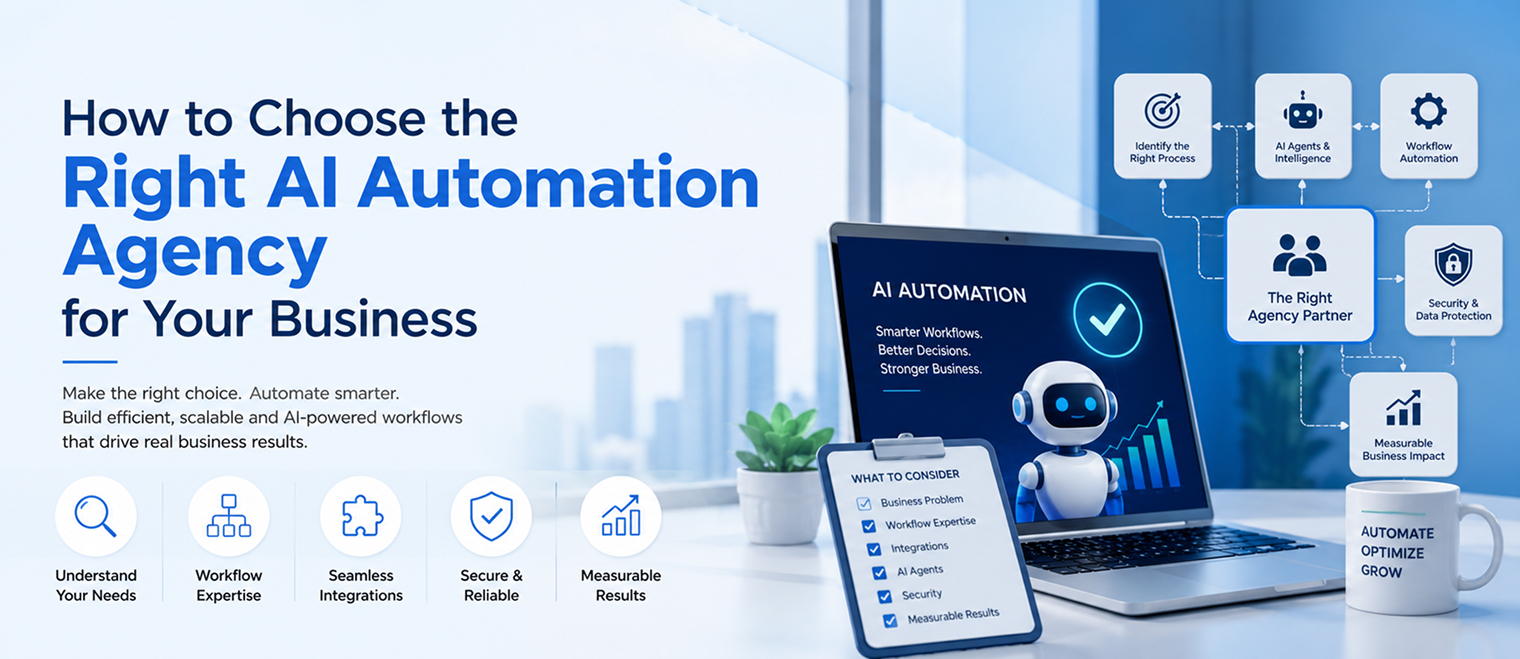

Artificial intelligence is changing the way businesses handle everyday work. Tasks that once took hours of manual effort can now be completed faster through connected systems, intelligent workflows, and AI-powered tools.
Companies are using AI to qualify leads, answer customer questions, process documents, generate reports, update records, and manage repetitive administrative tasks. But simply purchasing an AI tool does not automatically make a business more efficient.
The real challenge is knowing what to automate, choosing the right technology, connecting it with your existing systems, and making sure the solution delivers measurable results.
That is why selecting the right AI automation agency is such an important decision.
A reliable agency will not push the latest platform simply because it is popular. It will take the time to understand how your business operates, identify where automation can make a meaningful difference, build the right solution, and support it after launch.
Here is what to consider when choosing an AI automation partner for your business.
What Does an AI Automation Agency Do?
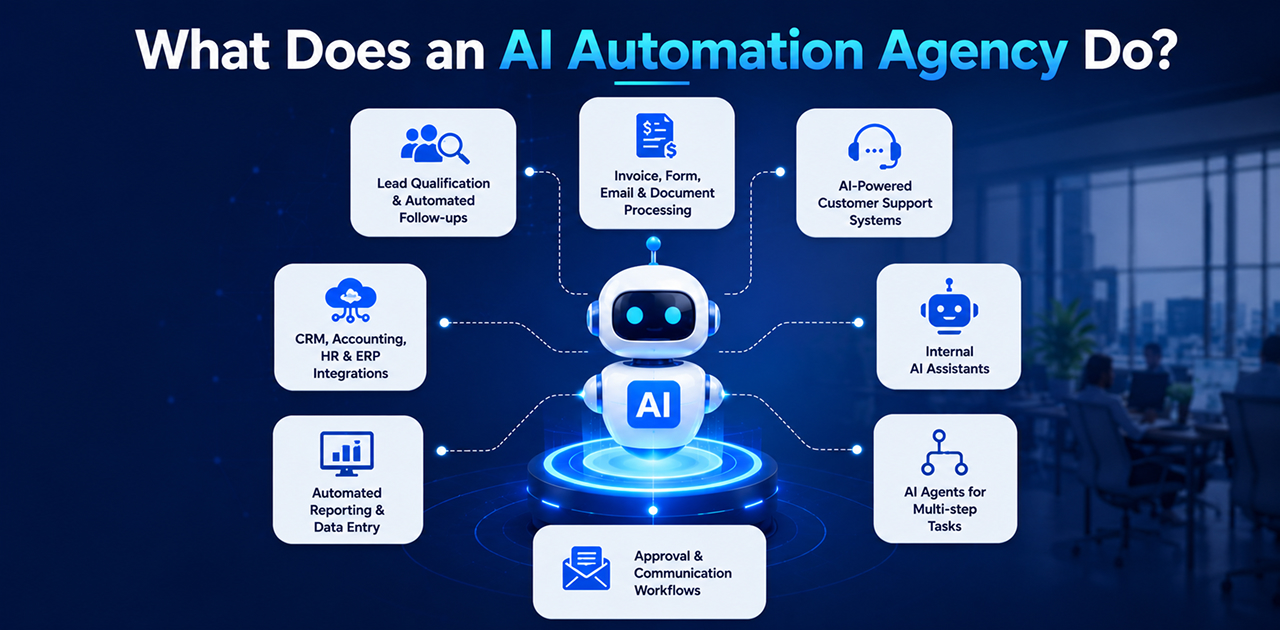
An AI automation agency helps businesses improve their operations by combining artificial intelligence, workflow automation, software integrations, and custom development.
The agency studies how work moves through your organization and identifies tasks that can be completed faster, more accurately, or with less manual effort.
Common AI automation services include:
- Lead qualification and automated follow-ups
- Invoice, form, email, and document processing
- AI-powered customer support systems
- CRM, accounting, HR, and ERP integrations
- Internal AI assistants
- Automated reporting and data entry
- AI agents for multi-step tasks
- Approval and communication workflows
The goal is not to replace every employee or remove people from every process. Effective automation reduces repetitive work so employees can focus on decisions, customer relationships, creative problem-solving, and business growth.
A capable agency should also understand when AI is helpful and when a traditional workflow or human review is still the better choice.
Start With a Clear Business Problem
Before contacting an AI automation company, identify the operational challenge you want to solve.
You do not need to know which AI model, platform, or software should be used. A good agency will help you determine that. However, you should know where your team is losing time, making mistakes, or dealing with unnecessary delays.
For example:
- Sales representatives spend too much time entering lead information.
- Customer support teams repeatedly answer the same questions.
- Employees copy data between multiple applications.
- Finance teams manage invoices and approvals through email.
- Managers build reports by gathering data from different systems.
- Important customer inquiries are not assigned quickly enough.
A trustworthy agency will investigate these problems before recommending a solution.
Be cautious when an agency suggests a specific tool during the first conversation without learning how your business works. The technology should fit the business problem—not the other way around.
Look for Workflow Automation Experience
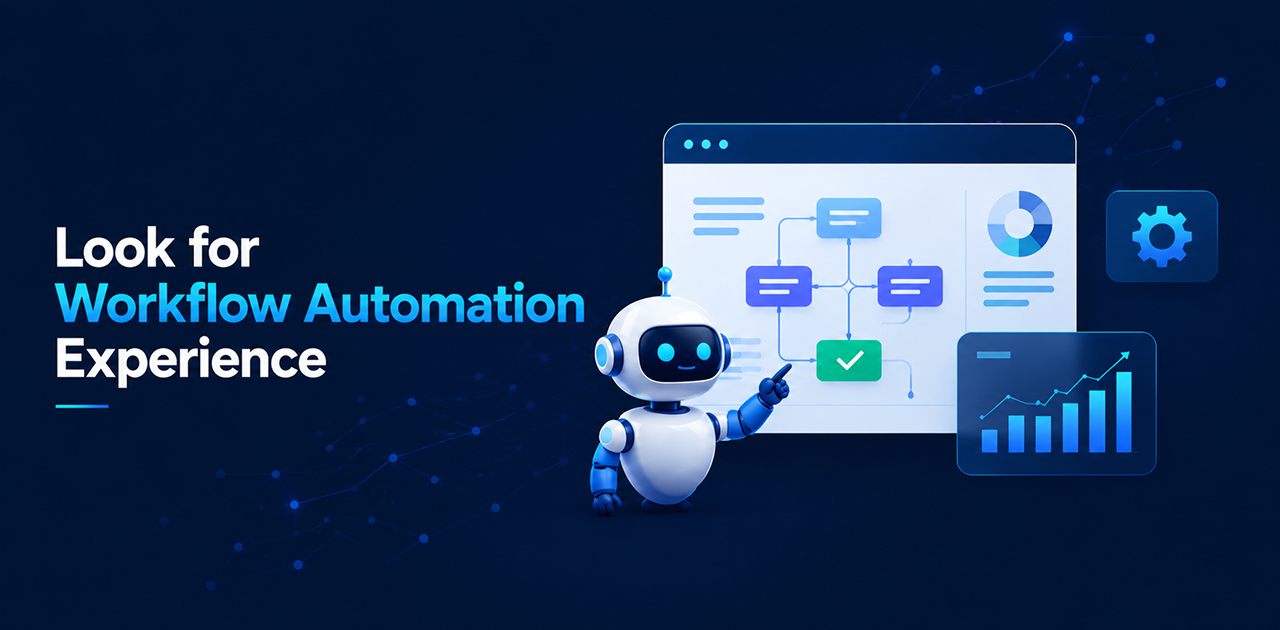
AI automation is not just about adding artificial intelligence to one task. It often requires redesigning the entire workflow.
A business process may involve several employees, software platforms, approval stages, and decision points. Automating one isolated step may save a little time but still leave the larger problem unresolved.
Consider invoice processing. Extracting information from an invoice is only one part of the process. A complete automation may also need to:
- Verify vendor details
- Match invoices with purchase orders
- Detect duplicate submissions
- Apply approval rules
- Update accounting software
- Notify the appropriate employee
- Flag incomplete or unusual invoices
An experienced agency will examine the entire process before building anything.
Strong AI workflow automation should include clear triggers, data movement, decision rules, approvals, exception handling, and measurable outcomes. Ask potential agencies how they map workflows and decide which steps should remain under human control.
Evaluate Custom Development Capabilities
Platforms such as Zapier, Make, n8n, and Microsoft Power Automate are useful for connecting applications and building straightforward workflows.
However, they are not suitable for every project.
Your business may need custom logic, secure databases, specialized dashboards, private AI environments, legacy software integrations, advanced permissions, or industry-specific features.
In those cases, the agency should be able to combine automation platforms with custom AI software development.
An agency that relies on only one tool may try to force every project into the same structure. This can create security, performance, and scalability issues later.
At the same time, building every component from scratch can increase cost and complexity unnecessarily. The right agency should be able to recommend:
- An existing automation platform
- A fully custom AI solution
- A hybrid approach using both
The recommendation should depend on your workflow, security needs, current systems, number of users, budget, and long-term plans.
Check Its Integration Experience
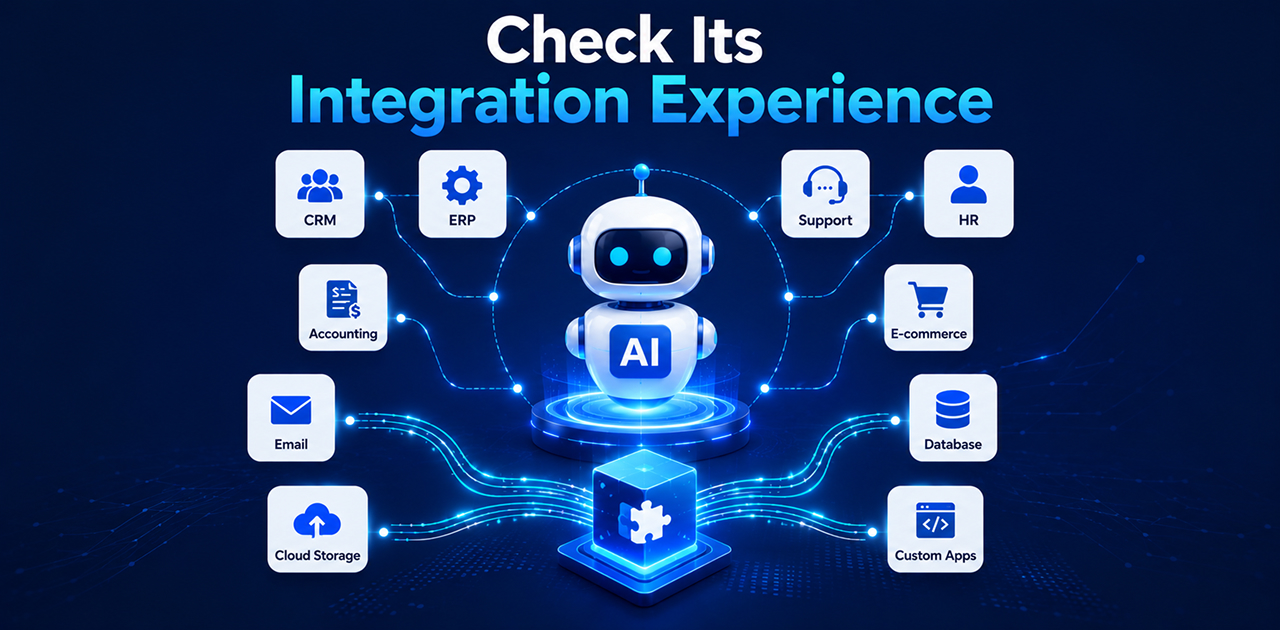
Most AI automation solutions need to work with the software your company already uses, including:
- CRM systems
- ERP platforms
- Accounting software
- Customer support tools
- Email and communication platforms
- HR management systems
- E-commerce platforms
- Cloud storage
- Internal databases
- Custom applications
Automation only works when information moves accurately and reliably between these systems.
For example, an AI sales workflow may receive a new inquiry, analyze the prospect’s requirements, review previous CRM activity, qualify the lead, assign it to a salesperson, and schedule a follow-up task.
If one integration fails, the workflow may stop, duplicate information, or create incomplete records.
Ask the agency about its experience with APIs, webhooks, authentication, data synchronization, error tracking, and legacy systems. It should also explain how the automation will respond if one of your applications becomes temporarily unavailable.
Reliable integration is one of the most important foundations of successful AI business automation.
Ask About AI Agent Development
AI agents can handle more advanced tasks than basic rule-based workflows.
An AI agent may interpret a request, retrieve relevant information, choose an action, use connected tools, and continue working until the task is complete.
Businesses can use AI agents to:
- Research and enrich sales leads
- Review documents
- Prepare customer responses
- Search internal company knowledge
- Update CRM records
- Summarize meetings
- Coordinate follow-up activities
- Handle common employee requests
However, AI agents need clear boundaries.
An agent that can access customer data, send messages, or update financial records must be carefully controlled. The agency should define what the agent can access, what actions it can take, and when human approval is required.
Ask how the agency handles permissions, output verification, activity monitoring, and unexpected situations.
Good AI agent development is not about making a system completely autonomous. It is about giving the system enough intelligence to be useful while keeping your business in control.
Do You Really Need a Multi-Agent System?
Some complex processes may benefit from multiple AI agents working together. One agent may collect information, another may analyze it, and a third may prepare the final response.
This approach can be valuable, but it is not necessary for every business.
Multi-agent systems can increase development time, operating costs, technical complexity, and monitoring requirements. In many cases, one AI agent or a structured workflow can produce the same result more reliably.
A trustworthy agency should explain why a multi-agent system is needed. It should not recommend one simply because multi-agent AI is attracting attention.
The architecture should be based on business value, reliability, and practical requirements—not technical excitement.
Review the Agency’s Approach to Data Security
AI automation systems may interact with customer details, employee information, contracts, financial records, and confidential business documents.
Security should be discussed before development begins.
Ask questions such as:
- What data will the system access?
- Where will the data be stored?
- Will information be shared with third-party AI providers?
- How will data be encrypted?
- How will user permissions be managed?
- Will the system maintain activity logs?
- Which actions will require human approval?
- How will sensitive information be protected?
The agency should follow the principle of least privilege. In other words, the AI system should only access the information required to complete its assigned task.
Human oversight should remain in place for high-impact activities involving payments, legal documents, sensitive communications, or permanent changes to company records.
Examine the Development Process
A professional AI automation agency should follow a clear, structured development process.
1. Business and Workflow Discovery: The agency reviews your current systems, processes, challenges, and desired outcomes.
2. Automation Opportunity Assessment: Potential use cases are compared based on value, feasibility, risk, cost, and implementation effort.
3. Solution Planning: The team selects suitable AI models, automation platforms, integrations, databases, and infrastructure.
4. Prototype Development: A limited version may be created to confirm that the proposed approach works.
5. Development and Integration: The full solution is built and connected with your existing business systems.
6. Testing and Deployment: The workflow is tested with normal, incomplete, incorrect, and unusual inputs before launch.
7. Monitoring and Optimization: After deployment, the agency monitors performance and improves prompts, rules, integrations, and workflow steps.
Avoid agencies that move from an introductory call directly into full development without proper discovery, planning, and testing.
Define How Success Will Be Measured
A successful automation project should improve a measurable business outcome.
Before development begins, agree on the results you expect. These may include:
- Fewer hours spent on repetitive work
- Faster customer response times
- Reduced manual data entry
- Lower error rates
- Faster document processing
- More consistent communication
- Better lead follow-up
- Fewer pending approvals
- Higher employee productivity
- Improved workflow completion rates
An impressive AI demo means very little if the final system does not save time, reduce errors, improve service, or support growth.
Start With One High-Value Process
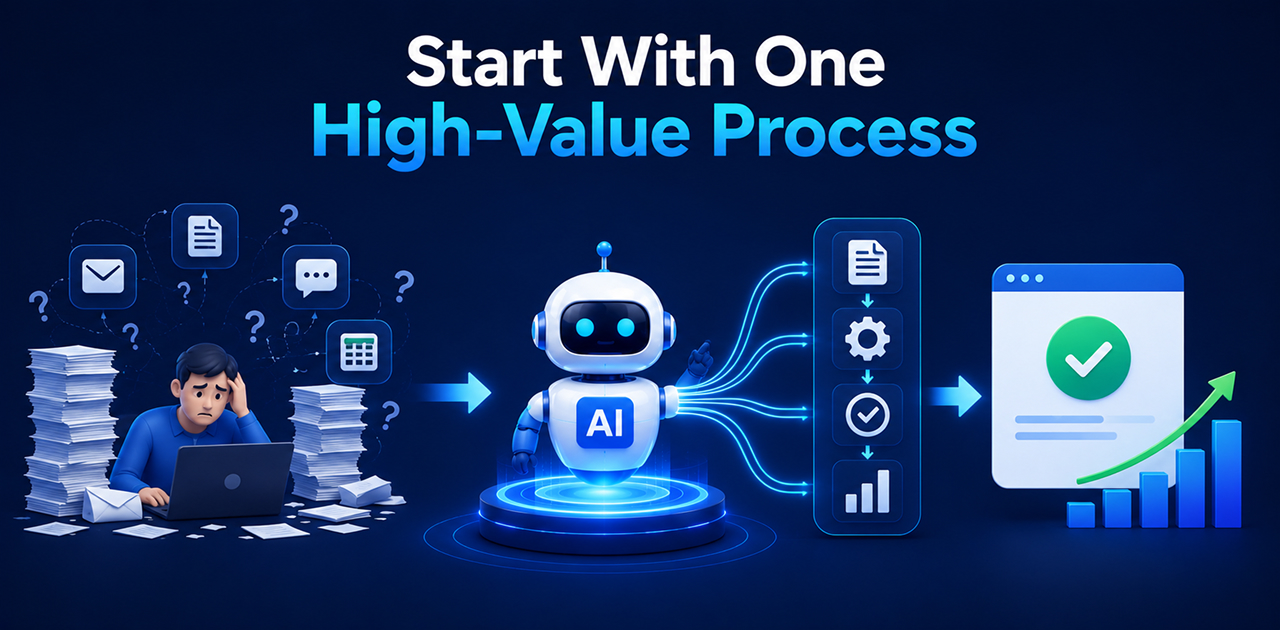
Trying to automate several departments at once can create unnecessary complexity.
A focused first project is usually more effective.
Choose a process that happens frequently, consumes significant employee time, has clear inputs and outcomes, and can be measured easily.
Strong starting points include:
- Lead qualification
- Support ticket categorization
- Document data extraction
- Report generation
- Internal knowledge search
- Customer inquiry routing
- Employee request management
Starting small allows you to evaluate the agency’s communication, technical quality, and post-launch support before expanding automation across the business.
Warning Signs to Watch For
An agency may not be the right partner if it:
- Recommends a platform before understanding your workflow
- Promises to automate everything
- Avoids discussing errors and exceptions
- Cannot explain its security practices
- Provides no measurable success criteria
- Has no plan for human oversight
- Treats a prototype as a production-ready system
- Offers no support after launch
- Cannot explain who owns the code, data, and system accounts
The best AI automation companies are honest about what AI can and cannot do.
Why Choose Thinkwik as Your AI Automation Partner?
Thinkwik helps businesses turn automation ideas into practical, secure, and scalable solutions.
Rather than focusing on a single tool, Thinkwik approaches each project through workflow analysis, software engineering, system integration, and long-term optimization.
Its capabilities include:
- AI workflow automation
- Intelligent document processing
- AI-powered customer support
- AI agent development
- Business process automation
- Enterprise software integration
- Custom AI software development
- Testing, deployment, and ongoing optimization
This combination is especially valuable for businesses that need more than a basic connection between two applications.
Thinkwik can assess your current process, recommend the right technology, build custom components, connect existing software, test the complete workflow, and support the solution after deployment.
The team can use established automation platforms when they are the best fit while developing custom systems for more complex or specialized requirements.
This flexible approach helps businesses avoid unnecessary technical complexity without sacrificing security, performance, or scalability.
For companies exploring AI transformation services, Thinkwik provides a clear path from identifying the first automation opportunity to building broader AI capabilities over time.
Final Thoughts
Choosing the right AI automation agency requires more than comparing service lists, platforms, or technical terminology.
The best partner will take the time to understand your workflow, recommend a realistic solution, integrate it with your existing systems, protect your data, and define how success will be measured.
It should also know when an off-the-shelf automation platform is enough and when custom development is the smarter choice.
Most importantly, the agency should focus on solving a real business problem.
Thinkwik combines AI automation services, workflow design, AI agent development, system integration, and custom software engineering to help businesses create solutions that are practical, secure, and built for long-term growth.
Start with one process that is slowing your team down. With the right strategy and technology partner, it can become faster, more reliable, and much easier to manage.