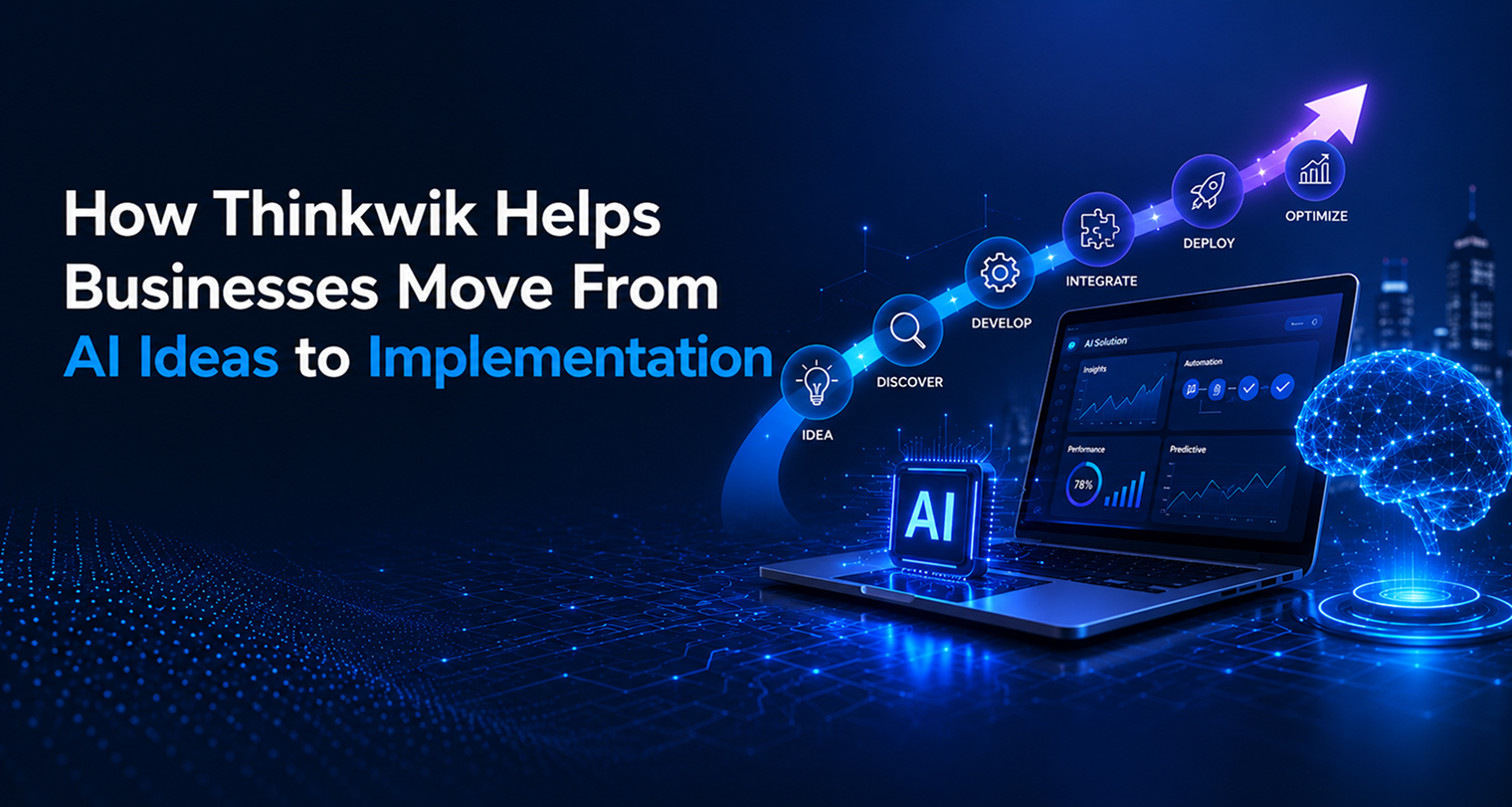

Many businesses already have ideas about how artificial intelligence could automate customer support, analyze large volumes of data, build an intelligent digital product, personalize user experiences, or reduce repetitive work.
The challenge is rarely coming up with an AI idea. The challenge is turning that idea into reliable software that employees and customers can actually use.
Successful AI Software Development requires more than selecting a model or connecting an AI API. Businesses must identify the right problem, prepare their data, validate technical feasibility, design a scalable architecture, integrate the solution with existing systems, test its performance, and continue improving it after launch.
This is where Thinkwik helps businesses move forward.
Thinkwik combines AI expertise, product engineering, software architecture, automation, and business strategy to transform early concepts into secure, scalable, and practical AI solutions. Instead of treating AI as an isolated technical experiment, the team focuses on building software that supports real business goals and delivers measurable value.
Why Many AI Ideas Never Reach Implementation
AI discussions often begin with exciting possibilities.
A company may want an AI assistant that answers customer questions. A logistics business may want to predict delivery delays. A healthcare organization may want to organize clinical information. A retailer may want to recommend products based on customer behavior.
However, an interesting idea does not automatically become a useful product.
Many AI initiatives struggle because the business problem has not been clearly defined. Others fail because the available data is incomplete, inconsistent, inaccessible, or unsuitable for the intended use case.
There may also be uncertainty around questions such as:
- Which AI technology should be used?
- Should the company build a custom solution or integrate an existing model?
- How will the software connect with current systems?
- What security and privacy requirements must be addressed?
- How will accuracy and performance be measured?
- Can the solution support more users and data in the future?
Without clear answers, businesses can invest significant time and resources into tools that never move beyond an experimental stage.
Thinkwik helps reduce this uncertainty by approaching Artificial Intelligence Software Development as a complete product journey rather than a single coding task.
How Thinkwik Turns AI Ideas Into Working Software
Thinkwik provides end-to-end AI Software Development Services, beginning with strategy and feasibility assessment and continuing through architecture, development, integration, deployment, monitoring, and optimization. Its services include AI consulting, custom AI development, AI integration, platform modernization, PoC and MVP development, enterprise AI software, workflow automation, and post-launch improvement. Its structured approach helps businesses make informed decisions before committing to full-scale development.
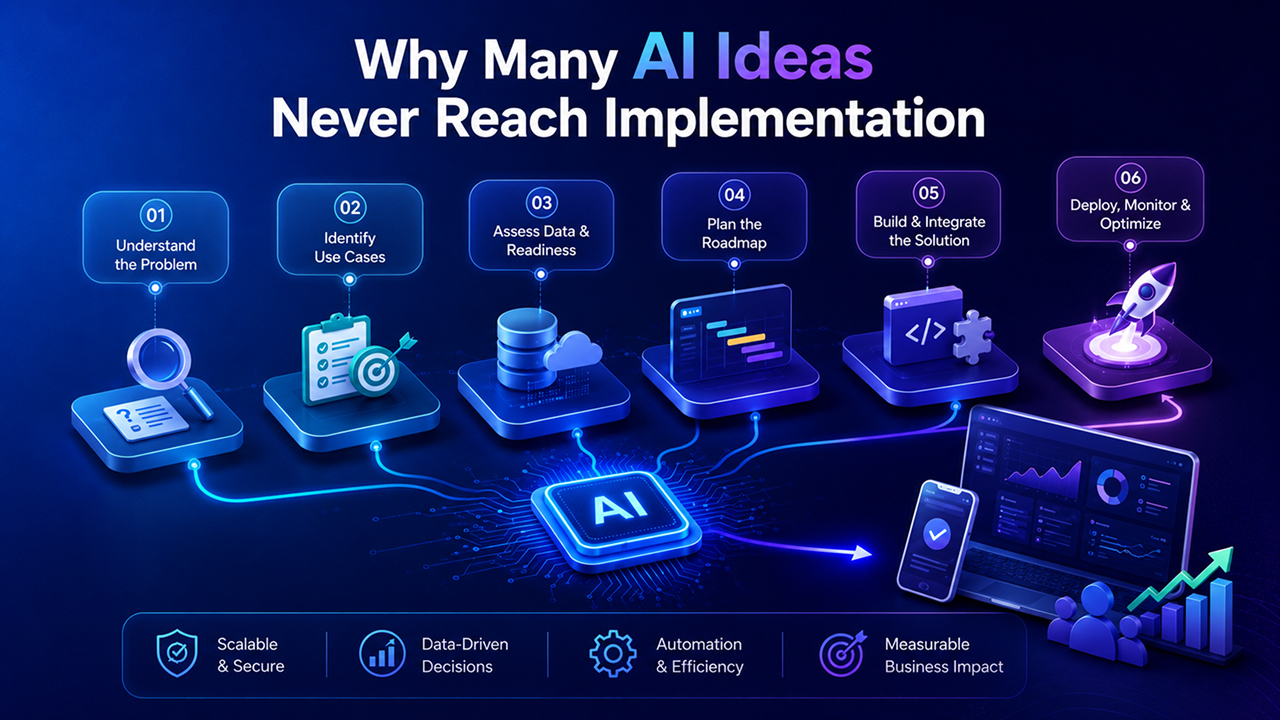
Understanding the Business Problem
The first step is not selecting an AI model. It is understanding what the business needs to improve.
Thinkwik works with stakeholders to examine current workflows, operational challenges, user expectations, available systems, and long-term objectives. This helps the team determine whether AI is genuinely suitable for the problem.
For example, a business may initially believe that it needs a chatbot. After analyzing the situation, the more valuable solution may be an internal AI assistant that helps support representatives search documentation and prepare accurate responses.
Another company may request predictive analytics when its immediate need is better data collection and reporting.
By beginning with the underlying problem, Thinkwik helps businesses avoid adding AI where it does not create meaningful value.
Identifying High-Value AI Use Cases
A business may have several possible AI applications, but attempting to build everything at once can increase cost, complexity, and delivery risk.
Thinkwik helps prioritize use cases based on factors such as:
- Expected business impact
- Technical feasibility
- Data availability
- Integration requirements
- Implementation complexity
- User adoption
- Potential return on investment
This allows the company to begin with a manageable project that can produce visible results.
A focused first implementation may automate document classification, summarize customer conversations, recommend relevant products, identify sales opportunities, or answer employee questions using internal knowledge.
Once the first use case has been validated, the software can be expanded into a broader AI Software Solution.
Assessing Data and Technical Readiness
AI systems depend heavily on the quality and accessibility of data.
Before development begins, Thinkwik evaluates where the required information is stored, how it is structured, who can access it, and whether it is accurate enough to support the intended system.
The team may review databases, documents, CRM platforms, business applications, analytics systems, APIs, and cloud environments. It can then identify gaps that should be addressed before implementation.
This assessment also helps determine whether the project requires machine learning, generative AI, natural language processing, computer vision, predictive analytics, retrieval-augmented generation, or a combination of technologies.
A careful readiness assessment prevents businesses from building sophisticated interfaces on top of unreliable data foundations.
Creating a Practical Development Roadmap
Once the problem and technical requirements are clear, Thinkwik creates an implementation roadmap.
The roadmap defines the proposed solution, core features, users, integrations, architecture, development phases, testing requirements, and measurable success criteria.
Instead of offering a vague promise to “add AI,” the roadmap explains what will be built and how it will support the business.
It may also define which features should be included in the first release and which can be added later. This phased approach helps control scope while allowing the software to evolve based on user feedback and business needs.
Validating the Idea Through a PoC or MVP
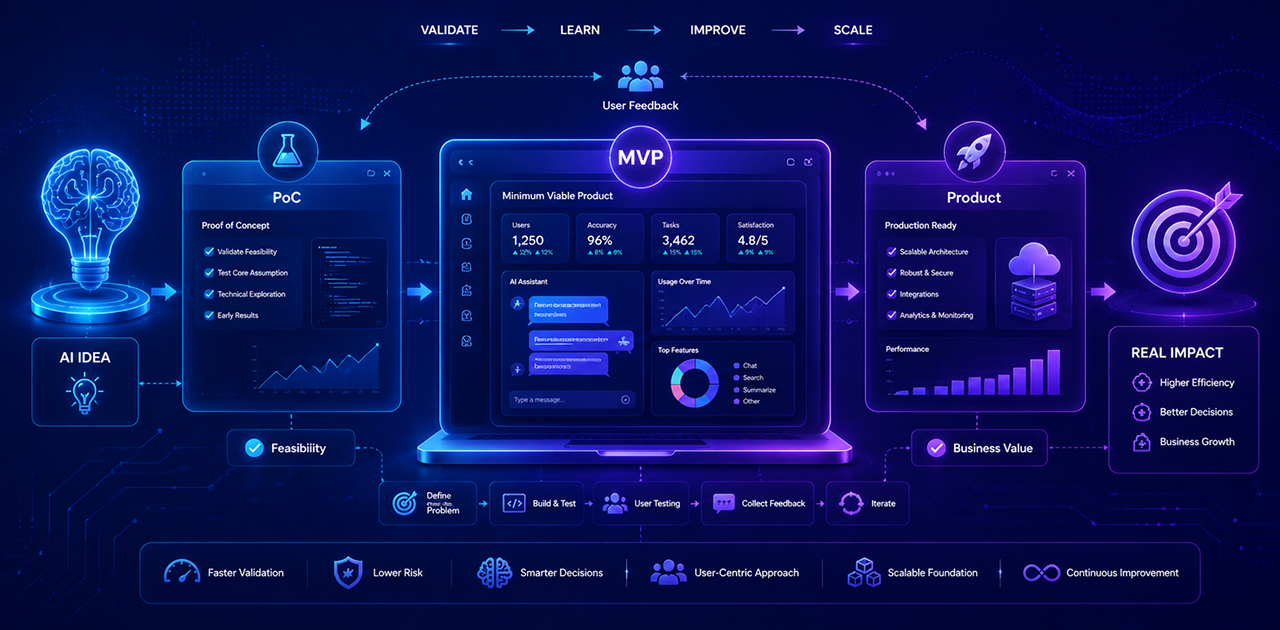
Building a full enterprise application before testing the central concept can create unnecessary risk.
Thinkwik offers proof-of-concept and minimum viable product development to help businesses validate an AI idea before scaling it into a complete system. This gives decision-makers an early opportunity to evaluate feasibility, accuracy, usability, and potential business value. A concept can answer a focused technical question, such as whether an AI model can accurately extract information from a specific type of document.
An MVP goes further by creating a usable version of the product with essential features. Selected users can test it in a real or controlled business environment.
Feedback from this stage helps the development team improve workflows, refine model behavior, resolve integration issues, and confirm which features matter most.
For startups, an MVP can also help demonstrate the product to investors or early customers. For established organizations, it can provide internal stakeholders with evidence before a larger investment is approved.
Building Custom AI Software Around the Business
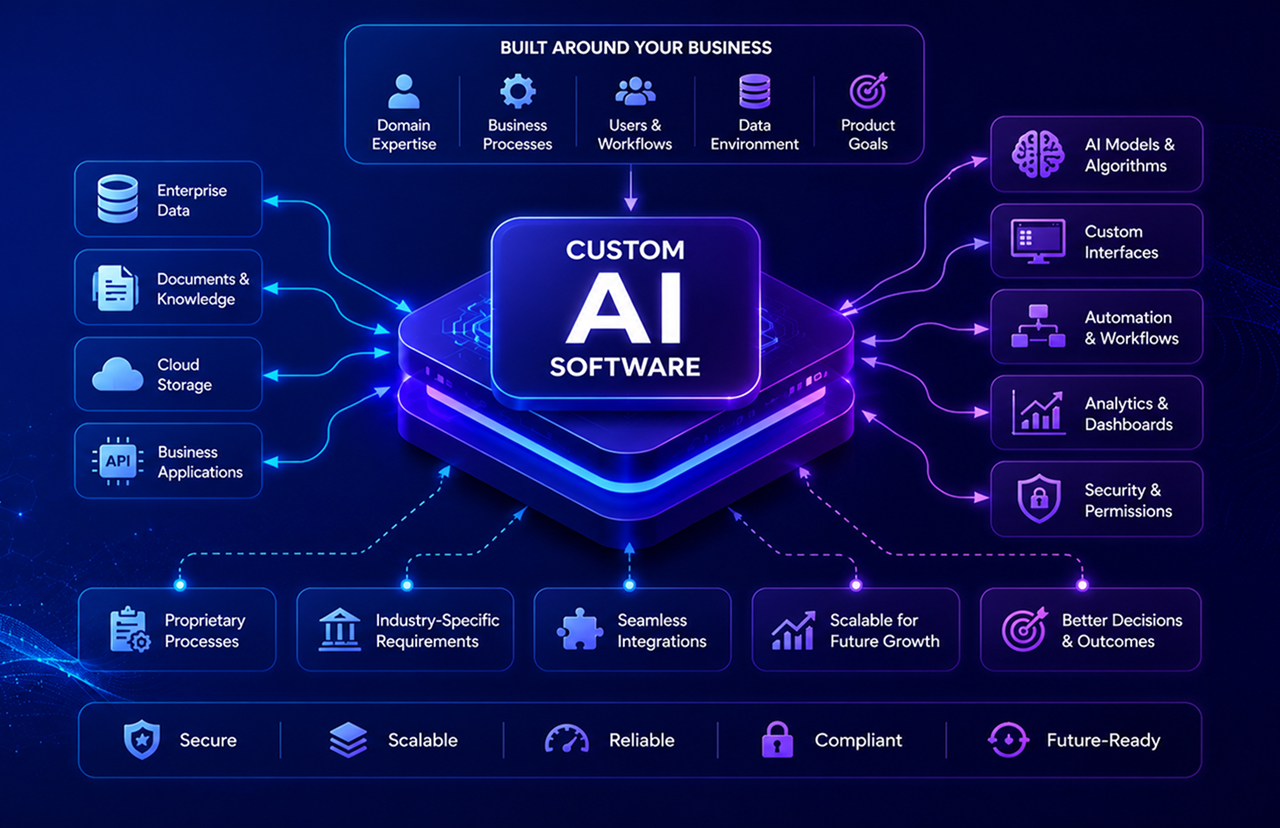
Custom AI Software Development gives businesses greater control over how AI works within their organization.
Thinkwik develops AI-powered software around the company’s domain, users, processes, data environment, and product goals. Depending on the project, the solution may include custom interfaces, business rules, dashboards, automated workflows, user permissions, analytics, model integrations, and administrative controls.
This approach is valuable when a business needs software that fits its operations rather than forcing employees to adjust to the limitations of a prebuilt tool.
Custom development can also support:
- Proprietary business processes
- Industry-specific requirements
- Internal knowledge and documents
- Existing customer or employee portals
- Specialized reporting
- Unique approval workflows
- Multiple business systems
- Long-term product expansion
Thinkwik’s custom AI software development capabilities cover generative AI applications, virtual assistants, AI copilots, intelligent automation, computer vision, recommendation systems, AI agents, NLP solutions, and decision-support platforms. Rating AI With Existing Business Systems
An AI application creates limited value when it operates separately from the systems employees already use.
To become useful, the solution may need to communicate with CRM software, ERP platforms, customer support tools, cloud storage, payment systems, internal databases, analytics platforms, or custom applications.
Thinkwik provides AI integration services that embed models, APIs, automation features, and intelligent workflows into existing software environments. This allows businesses to add new capabilities without unnecessarily replacing their current systems. For example, an AI assistant could retrieve customer information from a CRM, review previous support conversations, search internal documentation, and prepare a suggested response for an employee.
An intelligent document processing system could receive files, extract important data, validate the information, and update an existing business application automatically.
Integration turns AI from a standalone demonstration into a practical part of daily operations.
Designing Software for Security and Scalability
A successful prototype must eventually operate reliably in a real business environment.
Thinkwik designs modular, cloud-ready, and AI-ready software architecture that can support secure deployment, real-time processing, large datasets, growing user activity, and future model updates. Appropriate architecture depends on the use case, sensitivity of the data, number of users, expected workload, existing infrastructure, and compliance requirements.
Development decisions may include:
- Cloud, on-premises, or hybrid deployment
- User authentication and access controls
- Data storage and encryption
- API security
- Monitoring and logging
- Model access controls
- Backup and recovery
- Performance and latency management
Considering these requirements early helps businesses avoid expensive redesigns when the product begins to grow.
Testing More Than the Code
Traditional software testing verifies whether features behave as expected. AI software requires additional evaluation because model outputs can vary.
Thinkwik’s development process can assess both the software and the AI behavior.
This may include testing model accuracy, output relevance, response consistency, processing speed, error handling, security, usability, and performance under different levels of demand.
Human review is particularly important when the system supports sensitive or high-impact decisions. Businesses may need approval workflows, confidence scores, source references, or escalation processes rather than fully autonomous execution.
The goal is not simply to make the software technically functional. It must also be dependable enough for real users and business operations.
Launching, Monitoring, and Improving the Solution
AI implementation does not end when the software is deployed.
User behavior changes, business processes evolve, new data becomes available, and AI models continue to advance. A solution that performs well during initial testing may need adjustments after it encounters real-world requests and edge cases.
Thinkwik provides post-launch support that can include performance monitoring, model updates, feature improvements, scaling assistance, software optimization, and ongoing maintenance. A continuous improvement approach helps the software remain relevant as the organization grows.
Teams can review how employees or customers are using the system, where they encounter difficulties, which features create the most value, and where additional automation may be useful.
Instead of launching a static product, the company gains an AI Business Software platform that can develop alongside its needs.
AI Software Solutions Thinkwik Can Develop
Thinkwik can support a wide range of practical AI applications.
AI Assistants and Chatbots
AI assistants can help customers find answers, guide employees through internal processes, support sales teams, and provide self-service access to information.
They can be connected to company documents, databases, websites, applications, or support platforms to provide responses based on relevant business information.
Workflow Automation Software
AI automation can handle repetitive work such as classifying requests, extracting document data, updating records, routing tasks, preparing reports, and triggering approvals.
This allows employees to spend less time on administrative work and more time on activities that require judgment, creativity, or customer interaction.
Predictive Analytics and Decision Support
AI analytics platforms can identify patterns, forecast outcomes, highlight anomalies, and convert large volumes of information into practical insights.
Businesses can use these systems to support demand planning, risk assessment, customer retention, inventory management, operational monitoring, and financial analysis.
Recommendation and Personalization Systems
Recommendation engines can personalize products, content, services, and user experiences based on behavior, preferences, and historical data.
These systems can help digital platforms improve relevance while making it easier for users to discover suitable options.
Intelligent Document Processing
Businesses often store valuable information in invoices, forms, agreements, reports, applications, emails, and scanned documents.
AI-powered document software can extract, classify, summarize, validate, and organize this information, reducing the need for manual processing.
Enterprise AI Software
Enterprise AI Software can connect multiple teams, systems, and workflows across an organization.
These platforms may combine analytics, automation, AI assistants, knowledge retrieval, reporting, and decision support within a secure environment designed for long-term use.
Why Thinkwik Is a Strong AI Software Development Company
Choosing the right AI Software Development Company is an important decision because the partner must understand both technology and business operations.
Thinkwik stands out by providing support throughout the complete development lifecycle.
Strategy Before Development
Thinkwik begins by understanding the problem, evaluating readiness, and identifying the most practical implementation path. This reduces the risk of investing in technology that does not address the real business need.
Full-Cycle Development
The team supports consulting, architecture, design, custom development, integration, testing, deployment, optimization, and post-launch improvement.
Businesses do not need to coordinate separate agencies for strategy, AI development, software engineering, and ongoing support.
Experience Across AI Technologies
Thinkwik works with generative AI, AI agents, chatbots, machine learning, natural language processing, computer vision, predictive analytics, recommendation systems, and workflow automation. Its published technology stack includes Python, TensorFlow, PyTorch, OpenAI, LangChain, AWS, Microsoft Azure, Google Cloud, Docker, and Kubernetes. On Practical Business Use
The team builds AI Software Solutions around real workflows and measurable objectives rather than adding AI features simply because they are popular.
This keeps the implementation connected to productivity, customer experience, operational efficiency, decision-making, or product growth.
Flexible Development Models
Different projects require different levels of control and flexibility. Thinkwik offers fixed-bid, time and materials, dedicated team, and outstaffing engagement options to support defined projects as well as evolving product requirements. -Term AI Commitment
Thinkwik established its own AI Lab in 2025 and reported growing its team to more than 100 members, strengthening its ability to work on larger and more advanced technology projects. Investment reflects a long-term focus on AI development rather than a temporary expansion into a trending service.
Thinkwik as an AI Automation Company
Some businesses need a new AI product. Others need to make their existing operations faster and more efficient.
As an AI Automation Company, Thinkwik can examine repetitive processes, identify where intelligence can improve the workflow, and create software that connects people, data, and existing systems.
This may involve an AI agent completing a sequence of tasks, a document-processing workflow updating business records, or an internal assistant helping employees retrieve information.
The objective is not to remove human involvement from every process. It is to reduce unnecessary effort while allowing employees to retain control over decisions that require experience or judgment.
How Businesses Can Prepare for an AI Development Project
A company does not need to have every technical detail decided before contacting Thinkwik.
However, it is helpful to define the business situation as clearly as possible.
Consider what process is currently slow, expensive, inconsistent, or difficult to scale. Identify who experiences the problem and what a better outcome would look like.
It is also useful to consider where the relevant information is currently stored and whether the organization has examples that can be reviewed during discovery.
Thinkwik can then help translate these business requirements into a practical technical roadmap.
Move From AI Possibility to Practical Implementation
An AI idea becomes valuable only when it is transformed into software that works reliably within the business.
That transformation requires more than access to powerful technology. It requires a clear strategy, suitable data, thoughtful architecture, experienced engineering, secure integration, careful testing, and continuous improvement.
Thinkwik brings these capabilities together through end-to-end AI Software Development Services.
Whether you are exploring an early AI concept, validating a product through an MVP, modernizing existing software, automating internal operations, or building an enterprise-grade platform, Thinkwik can help you move from discussion to implementation.
Instead of allowing a promising idea to remain on a presentation slide, partner with Thinkwik to turn it into a scalable AI solution designed around your business, users, and long-term goals.